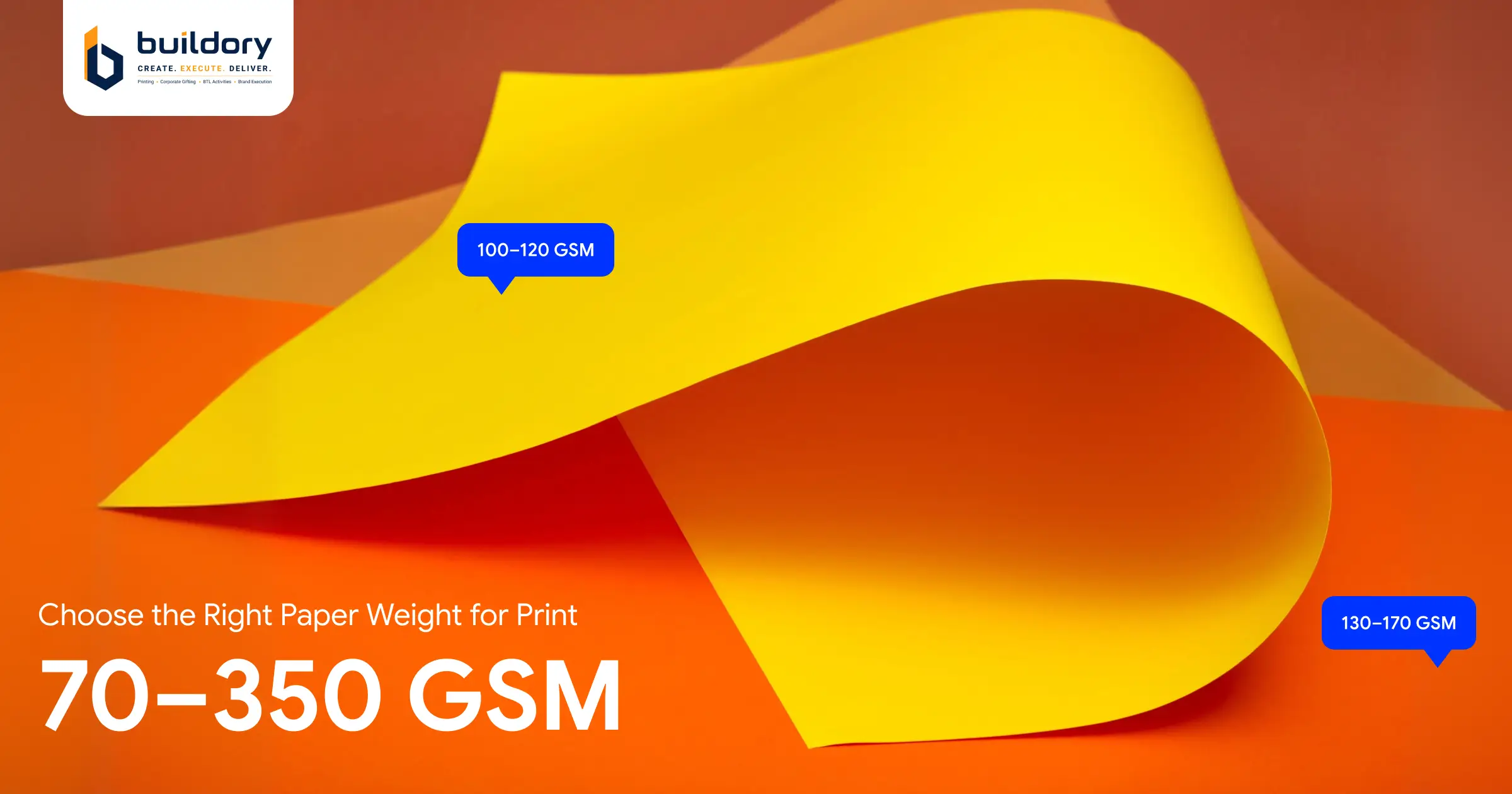
A client once told me their new brochures “felt cheap” and couldn’t say why. I knew immediately. The layout matched the approved sample and the print was flawless — the only thing that had changed was the paper. That single specification, GSM, was ruining the whole impression.
Paper GSM Guide | Paper GSM is the single most important number in print procurement, and the one most brand managers never specify. Get the paper weight right and your materials feel considered and premium. Get it wrong and even beautiful design lands like a flyer. Here’s how to choose the right GSM with confidence.
What does GSM mean in paper?
GSM stands for grams per square metre — it’s the weight of a single square metre of the paper. Higher GSM generally means a heavier, sturdier sheet; lower GSM means a lighter, thinner one. It’s the number that, more than any other, your hand reads as “quality” within the first second of touching a page.
GSM is paper weight, not thickness
Here’s the nuance most guides skip: GSM measures weight, not thickness. Two papers at the same GSM can feel different because of bulk and coating. A 130 GSM matte art (coated) sheet is thinner and smoother than a high-bulk 130 GSM uncoated sheet of the same weight. So when you specify paper, think in two dimensions — the weight (GSM) and the finish (coated/uncoated, matte/silk/gloss). Together they decide how the piece feels.
What GSM should you use? A quick-reference paper weight chart
Use this as a starting point for most Indian B2B contexts, then adjust for finish and budget:
Application | Recommended GSM | Notes |
|---|---|---|
Internal office documents | 70–100 GSM | Functional only — never for client-facing brand materials |
Letterheads & office stationery | 100–120 GSM | The floor for anything that carries your brand |
Flyers & brochure/catalogue inner pages | 70–300 GSM | Where most quality marketing material lives |
Brochure & catalogue covers, posters | 200–300 GSM | Cover stock; gives a piece its ‘spine’ in the hand |
Hang tags & premium covers | 300–350 GSM | Sturdy, premium feel that holds its shape |
Folding cartons (mono-carton packaging) | 250–350 GSM | Retail packaging; rigid boxes use board over greyboard |
What is the best GSM for brochures and catalogues?
For brochure printing and catalogues, inner pages sit comfortably at 130–170 GSM, while covers move up to 200–300 GSM to give the piece structure and a confident, premium feel in the hand. Pair the right weight with the right finish — matte, silk or gloss lamination — and the difference is immediate.
Is higher GSM always better?
No — and this is where over-specifying costs you. Heavier isn’t automatically better; the right weight is the one that fits the job. Push a cover stock too high and it cracks when folded. Over-spec a mailer and postage climbs. Bind a thick book on heavy text pages and it won’t sit flat. The expert move isn’t “maximum GSM” — it’s the correct GSM for how the piece will be used.
The GSM mismatch problem — and how to avoid it
The most common quality failure in Indian corporate print is the GSM mismatch: a premium brand printed on standard-weight stock because no one specified otherwise. The job sheet didn’t mention GSM, the vendor defaulted to their house stock, and the materials arrived feeling wrong — with no one able to say why.
The fix is one line on every brief. Specify the GSM — and the finish — on every print order. It’s the cheapest lever you have for premium perception, and the easiest to forget. A reliable corporate printing partner will confirm paper weight with you upfront, rather than defaulting to whatever is on the floor.
Frequently asked questions
What is a good GSM for brochure printing? 130–170 GSM for inner pages, 200–300 GSM for covers.
What GSM is used for packaging? Folding cartons typically run 250–350 GSM; rigid boxes use thicker greyboard wrapped in a printed sheet.
Does GSM mean thickness? Not exactly. GSM is weight per square metre; thickness also depends on the paper’s bulk and coating.
Is higher GSM always better? No. The right GSM fits the use — over-specifying adds cost and can cause cracking, binding, or postage problems.
Keep reading
Brochure printing — paper, finish and binding choices for brochures.
Catalogue printing — stocks and binding for multi-page catalogues.
Packaging — folding cartons, rigid and mailer boxes explained.
Print finishing — lamination, UV and special finishes that change how paper feels.
Corporate printing services — end-to-end print and brand collateral across Delhi NCR.
Why print is still essential for modern marketing in 2026 — a related read from the Buildory blog.
About the author
Gaurav Gujral is the founder of Buildory, a corporate printing, packaging and brand-presence company in Delhi NCR. Buildory helps marketing, HR and procurement teams treat print as a deliberate brand touchpoint — with structured execution, reliable timelines and quality output.
Planning a print run? Explore our printing and packaging services, or write to hello@buildory.in.
Ready to print with Buildory?
Get a quote in 24 hours. Delhi NCR and pan-India delivery.
Buildory works with marketing, HR, and procurement teams across India.
You Might Also Like

Managing Multiple Marketing Campaigns Every Month? Here's Why Your Corporate Print Vendor Is Your Biggest Bottleneck
Large enterprises often manage multiple marketing campaigns every month across different brands, regions, dealer networks, and marketing channels. At that scale, the biggest variable in whether campaigns launch on time isn't the creative team, media buying, or field execution—it's the print vendor.
POS Printing Services: Why Your POSM Is in the Stockroom Instead of the Shop Floor
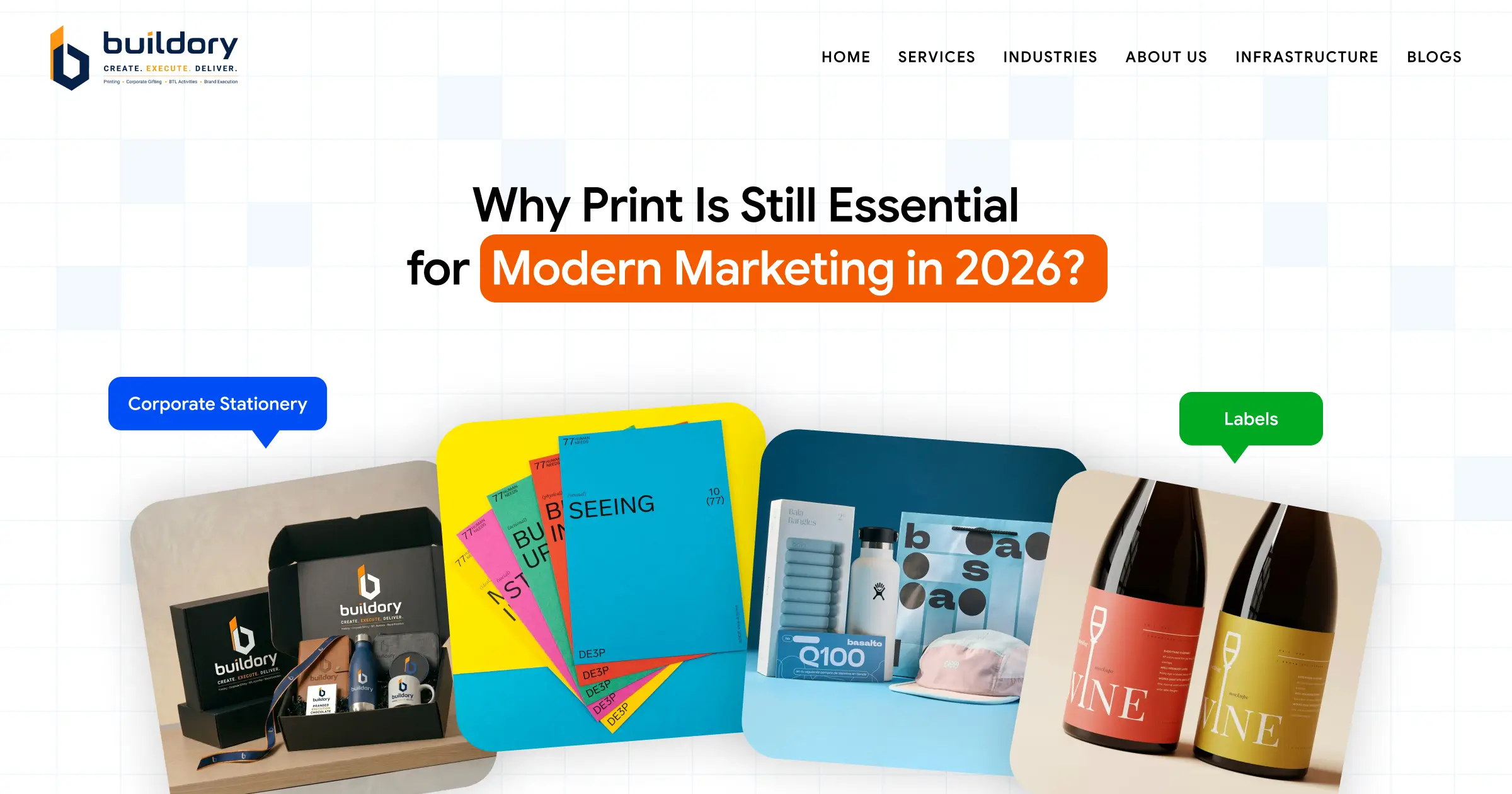
Why Print Is Still Essential for Modern Marketing in 2026 | Corporate Printing Services
Print isn't dead — it's been promoted. See why corporate printing services and physical brand execution still drive real business results in 2026.
Let's build something
that performs.
Share your requirement. Our team will get back with the right approach for timeline, scale and business objective.
Company
Buildory Private Limited
Location
New Delhi, India · Serving PAN India
Phone
+91 99999 01808
Let's Build Your Brand.