Introduction
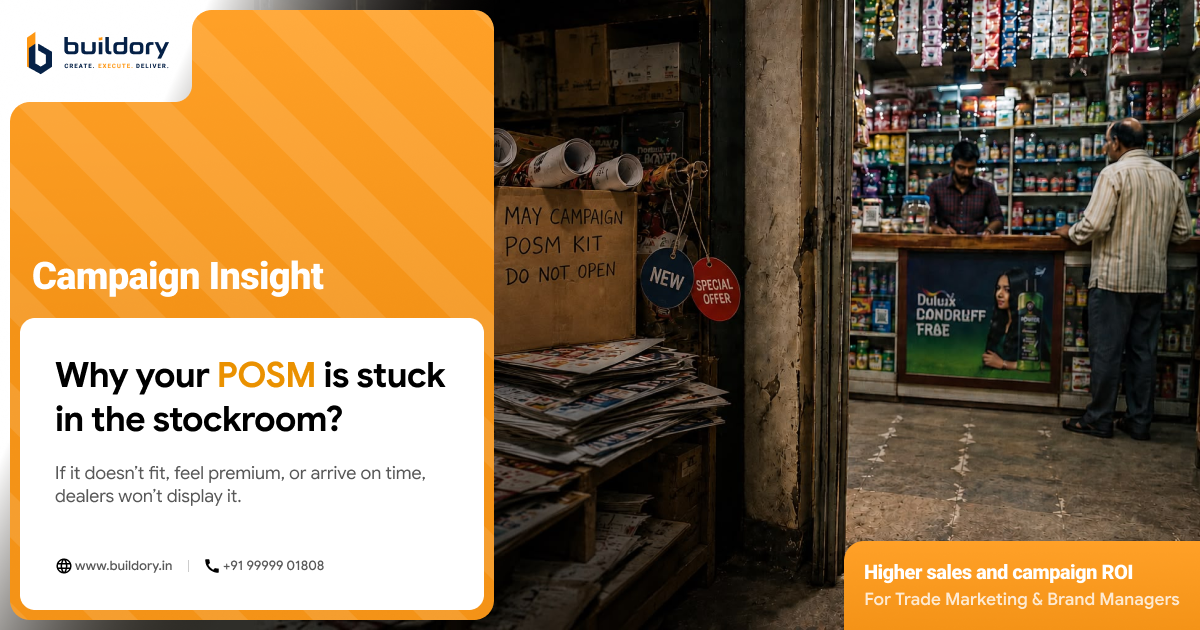
You spent weeks planning the campaign. The brief went to the vendor. The marketing collateral printing delivered on time. The boxes reached every outlet. And then, on your next market visit, you found your freshly printed posters rolled up behind the counter, your POP displays still in the plastic wrap, and your wobblers sitting in a box under the counter. POS printing services. POS printing services.
This is the POSM graveyard problem. It happens across every dealer network, in every city from Delhi NCR to the smallest Tier‑3 town. The frustrating truth is that it has very little to do with your dealers not caring, and almost everything to do with how the collateral was designed, produced, and delivered.
If you rely on POS printing services to drive visibility at the point of purchase, fixing this is one of the highest‑return actions you can take in trade and retail marketing.
Why do dealers not display POSM?
Dealers typically avoid displaying POSM when the materials feel low quality, are the wrong size for their store, are difficult to install, not localized to their language, or delivered after the campaign has already started.
Industry research, including POPAI’s Shopper Engagement Studies, shows that roughly 70–76% of purchase decisions are made in‑store, at the shelf or counter. When your POSM is sitting in the stockroom instead of on display, you’re invisible at the moment when most customers decide what to buy.
Cheap POSM Materials Reduce Dealer Display Rates
The first reason POSM ends up in the stockroom is simple perception. If a dealer receives a banner printed on flimsy material that curls at the edges, or a hang tag that tears on first use, the signal is clear: this is disposable, not something worth displaying.
From our experience executing retail merchandising and POS printing services across hundreds of outlets, the physical feel of the material is one of the strongest predictors of whether it will reach the shop floor. When a dealer holds material that feels premium, they display it. When it feels like a throwaway, it gets thrown away.
Offset printing standards and well‑specified substrates matter enormously here. A commercial printing company using high‑quality paper, lamination, and finishing delivers richer, more durable results than a lowest‑cost digital alternative with no specification discipline.
The fix: Your brief to any POS printing services or brochure printing partner must clearly specify paper weight, lamination, and finish. Print quality is not a luxury in trade marketing; it is the difference between material that earns shelf space and material that collects dust.
Missing Installation Guides Kill POSM Compliance
The box arrives. There is no installation guide. No instruction on where the wobbler should go. No visual showing how the shelf talker or hang tag is meant to attach.
Dealers and outlet staff are busy running their business. Decoding a box of POSM and shopper marketing materials is not their priority. If it takes more than five minutes to figure out what to do with it, it will sit in the box.
In our retail execution work, we see a direct correlation between clear installation guidance and store compliance. Where instructions are missing, POSM either never goes up or is installed in random, low‑impact positions.
The fix: Every kit from a printing execution partner should include a one‑page visual installation guide in the local language. Show the dealer exactly how the outlet should look: fascia, gondola ends, counter displays, shelf strips, danglers, and wobblers. Make it a two‑minute job, not a twenty‑minute puzzle.
Wrong Language Makes POSM Invisible
Marketing collateral printing that arrives in English‑only or Hindi‑only at an outlet in Tamil Nadu is not marketing collateral; it is paper. The same applies across India’s language landscape, from Coimbatore to Guwahati.
Custom label printing, product catalogue printing, price tags, and POSM must reflect the language reality of the market where they are deployed. A dealer and consumer in Coimbatore will not connect with messaging written for a consumer in Delhi NCR, no matter how good the design is.
The fix: Brief your print management company on your dealer network’s language breakdown before artwork is created, not after. Localization done at the design stage costs a fraction of what a reprint costs, and it dramatically improves dealer engagement and in‑store branding impact.
Late Delivery Turns Campaign POSM Into Waste
The campaign goes live digitally on Day 1. The POSM and marketing collateral printing arrive on Day 8. By then, the window has effectively passed. The dealer, having missed the launch moment, does not bother displaying materials for a campaign that already feels like yesterday’s news.
This is a printing execution partner problem, not a dealer problem. When your corporate printing vendor cannot commit to SLA‑backed delivery windows, every seasonal, sponsorship‑linked, or trade marketing campaign faces this timing gap.
The fix: Your business printing partner needs to operate on campaign calendars, not just purchase orders. A printing aggregator approach—where production is pre‑planned, material is pre‑stocked, and regional distribution is mapped before the brief is finalized—eliminates this delay and keeps POSM in sync with digital, ATL, and BTL activation.
What Happens When You Fix the POSM Graveyard
When brands fix these issues—quality, fit, guidance, language, and timing—POSM stops being a cost centre and starts behaving like a sales tool.
From our experience across FMCG, consumer durables, and multi‑city dealer networks, the impact shows up in three places:
POPAI’s research also indicates that nearly one in six brand purchases are made when a dedicated in‑store display for that brand is present. In other words, when your retail merchandising and POSM are properly installed, they don’t just decorate the store—they actively shift brand choice at the point of sale.
Higher installation and store compliance rates: More POSM actually reaches the shop floor and follows planograms, which lifts brand visibility and conversion at shelf and counter.
Better dealer relationships: Dealers see POSM as helpful retail merchandising, not as clutter. This improves dealer engagement and increases willingness to participate in future campaigns.
More efficient marketing spend: When materials are used, not stored, the cost per active outlet drops and the ROI on every rupee of trade marketing spend increases.
Shopper‑marketing and retail merchandising studies consistently report that poor POSM compliance can erase a significant share of trade marketing ROI, because the materials intended to support promotions and dealer engagement never reach the shopper’s line of sight.
Conclusion: Turn POSM Into a Sales Engine, Not a Storage Problem
If your POSM consistently ends up in the stockroom, the audit should begin with your print outsourcing partner, your briefing process, and your material specifications—not with your dealers. A structured approach to print and retail execution, with attention to:
Material quality and durability
Tiered sizing by outlet type
Clear installation guidance and visual merchandising
Language localization and dealer engagement
Campaign‑aligned production and delivery SLAs
Transforms POSM from a line item in the budget into a genuine sales engine.
Need to audit why your POSM isn’t reaching the shop floor? Buildory helps brands plan, print, localize, distribute, and execute retail marketing materials across India—ensuring your investment is seen by customers on the retail floor, not stored in the back room.
Ready to print with Buildory?
Get a quote in 24 hours. Delhi NCR and pan-India delivery.
Buildory works with marketing, HR, and procurement teams across India.
You Might Also Like
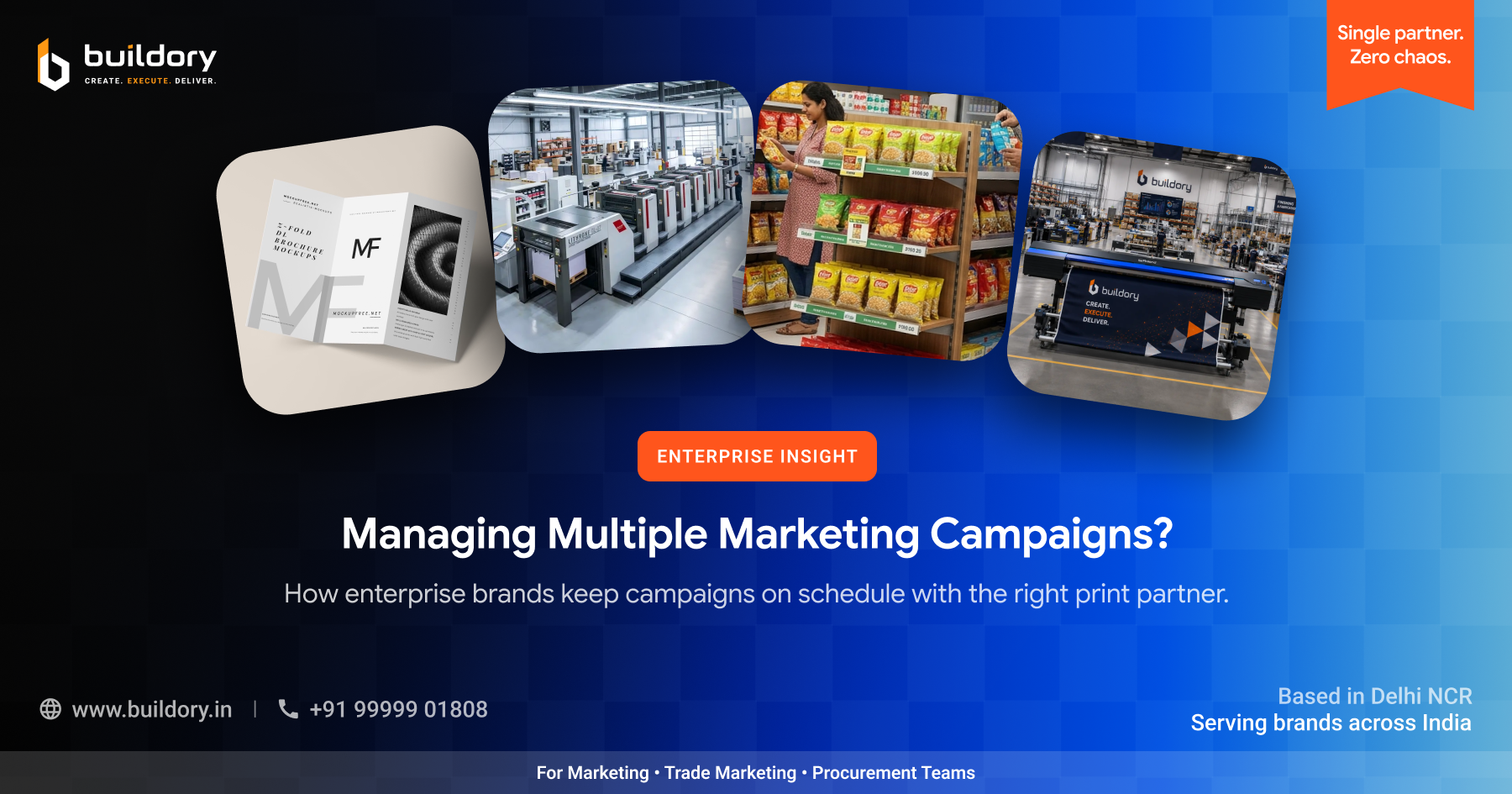
Managing Multiple Marketing Campaigns Every Month? Here's Why Your Corporate Print Vendor Is Your Biggest Bottleneck
Large enterprises often manage multiple marketing campaigns every month across different brands, regions, dealer networks, and marketing channels. At that scale, the biggest variable in whether campaigns launch on time isn't the creative team, media buying, or field execution—it's the print vendor.

Paper GSM Guide: How to Choose the Right Paper Weight for Print
Paper GSM is the single most important number in print procurement, and the one most brand managers never specify. Get the paper weight right and your materials feel considered and premium. Get it wrong and even beautiful design lands like a flyer. Here’s how to choose the right GSM with confidence – Paper GSM Guide.
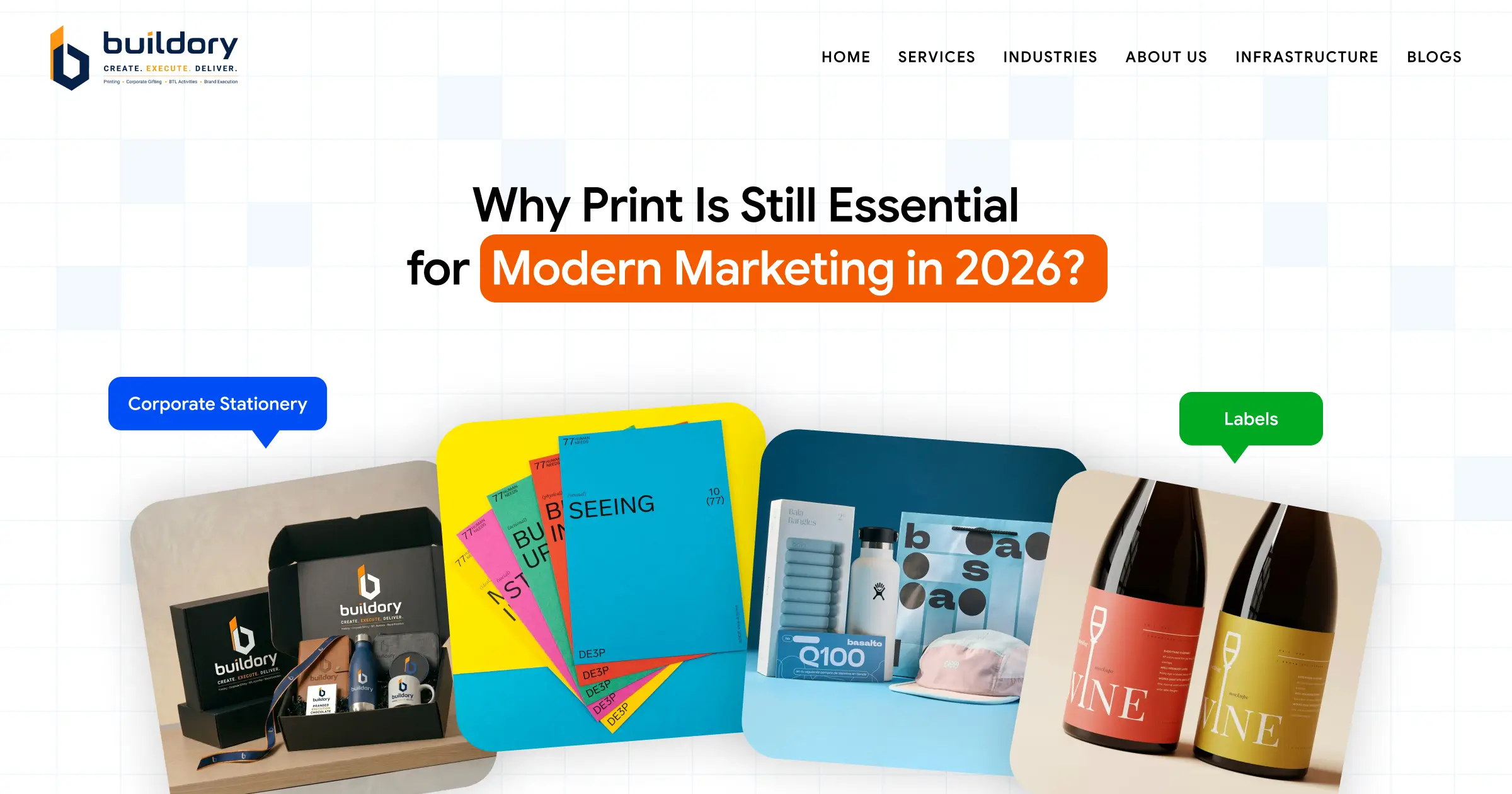
Why Print Is Still Essential for Modern Marketing in 2026 | Corporate Printing Services
Print isn't dead — it's been promoted. See why corporate printing services and physical brand execution still drive real business results in 2026.
Let's build something
that performs.
Share your requirement. Our team will get back with the right approach for timeline, scale and business objective.
Company
Buildory Private Limited
Location
New Delhi, India · Serving PAN India
Phone
+91 99999 01808
Let's Build Your Brand.